

Let’s be honest, most people don’t have months to sit through long cybersecurity courses. Business owners are busy. Employees are overloaded. Beginners feel overwhelmed. Yet cyber threats don’t wait. They happen every day, often because people didn’t have time to learn the basics.
This is where cybersecurity microlearning modules change the game.
Microlearning is exactly what it sounds like: short, focused lessons that teach one concept at a time. Instead of hours of theory, you get quick, practical knowledge you can apply immediately. Think of it like learning cybersecurity the same way you scroll short videos, quick, engaging, and memorable.
In this article, we’ll explore how cybersecurity microlearning works, why it’s so effective, and why learning in minutes, not months, is the future of cybersecurity education.
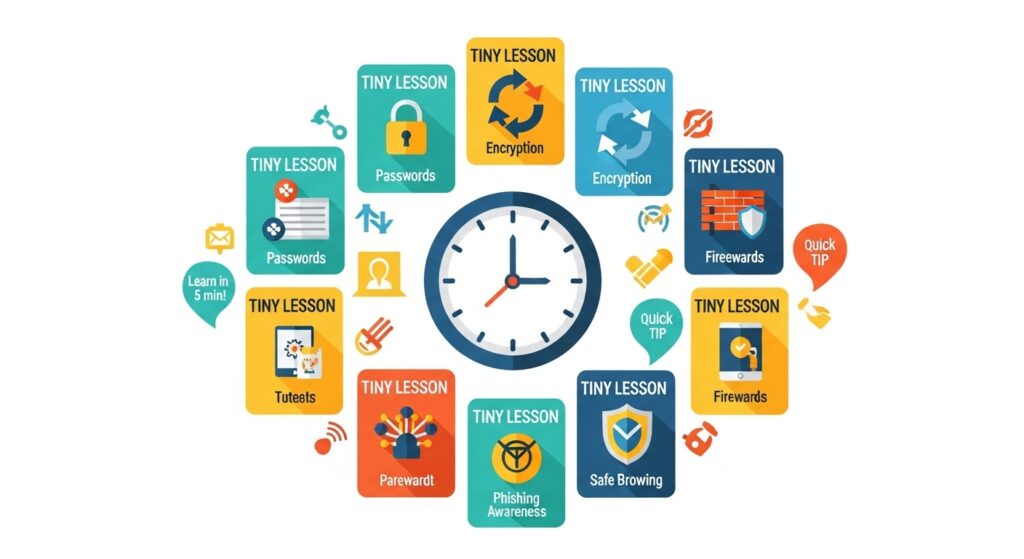
1. What Is Cybersecurity Microlearning
Cybersecurity microlearning breaks complex topics into short, focused lessons, usually lasting 3–10 minutes.
Each module covers:
- One concept
- One risk
- One solution
Instead of overwhelming learners, it delivers information in small, easy-to-digest pieces.
Imagine cybersecurity as a puzzle. Microlearning lets you solve one piece at a time instead of dumping the entire box on the table.
2. Why Traditional Cybersecurity Training Often Fails
Traditional training often looks like:
- Long videos
- Heavy technical language
- Information overload
- Low completion rates
People start motivated but quickly lose interest. The result? Poor retention and little real-world impact.
Microlearning fixes this by respecting attention spans and busy schedules.
3. Learn in Minutes, Not Months: How Microlearning Works
Microlearning focuses on speed + relevance.
Instead of:
“Complete this 40-hour course”
You get:
“Learn how phishing works in 5 minutes”
This approach allows:
- Faster learning
- Immediate application
- Better memory retention
You don’t learn everything at once, you learn what you need, when you need it.
4. Who Benefits Most from Microlearning Modules
Cybersecurity microlearning modules are ideal for:
- Busy professionals
- Business owners
- Employees
- Startups
- Beginners
- Non-technical teams
If time is limited, microlearning is the most realistic way to stay cyber-aware.
5. The Science Behind Microlearning Effectiveness
Microlearning works because of how the brain processes information.
Short lessons:
- Reduce cognitive overload
- Improve focus
- Increase retention
- Encourage repetition
It’s the same reason short reminders work better than long lectures.
6. Key Topics Covered in Cybersecurity Microlearning
Good microlearning modules cover essential topics such as:
- Password security
- Phishing awareness
- Email safety
- Data protection basics
- Safe browsing habits
- Malware awareness
- Remote work security
Each topic is broken into actionable lessons, not abstract theory.
7. Microlearning for Employees and Teams
Employees are often the first line of defense, and the weakest link if untrained.
Microlearning helps teams by:
- Minimizing work disruption
- Improving awareness without pressure
- Reinforcing good habits regularly
Instead of annual training sessions, teams learn continuously.
8. Microlearning for Business Owners
Business owners don’t need technical deep dives, they need clarity.
Microlearning helps owners:
- Understand risks quickly
- Make better decisions
- Ask smarter questions
- Reduce costly mistakes
A few minutes a day can protect months, or years, of hard work.
9. Microlearning for Beginners and Non-Technical Users
Cybersecurity doesn’t need to be technical to be effective.
Microlearning modules:
- Use simple language
- Focus on real-life examples
- Avoid jargon
- Build confidence
This makes cybersecurity accessible even for complete beginners.
10. Real-World Scenarios Over Theory
The best microlearning focuses on real situations, such as:
- Recognizing fake emails
- Spotting unsafe links
- Protecting login credentials
- Handling suspicious messages
This practical focus ensures learning sticks.
For globally recognized insights into real-world cybersecurity risks, many professionals refer to the OWASP Top 10, a trusted framework highlighting common security vulnerabilities.
Microlearning often aligns with these real threats in simplified form.
11. Microlearning vs Long-Form Cybersecurity Courses
| Microlearning | Traditional Courses |
| Short lessons | Long sessions |
| High engagement | High dropout rates |
| Practical focus | Theory heavy |
| Easy to repeat | Hard to revisit |
| Fits busy lives | Requires dedicated time |
Microlearning doesn’t replace deep training, it makes learning possible.
12. Building a Daily Cybersecurity Learning Habit
Consistency beats intensity.
A simple habit:
- 5–10 minutes per day
- One topic at a time
- Immediate application
Over time, these small lessons add up to strong cybersecurity awareness.
13. How Safelora Delivers Cybersecurity Microlearning
Safelora is built around the idea that learning should fit real life.
Their cybersecurity microlearning approach:
- Breaks complex topics into short modules
- Focuses on real-world risks
- Supports businesses, teams, and individuals
- Makes cybersecurity easy to understand
You can explore Safelora’s cybersecurity learning resources here: Cybersecurity Training for Business Owners: Protect Your Company Today
This makes Safelora an ideal platform for learning cybersecurity in minutes, not months.
14. Getting Started with Microlearning Today
You don’t need a big plan.
Start with:
- One short lesson
- One security habit
- One improvement at a time
Momentum builds naturally when learning feels achievable.
15. The Future of Cybersecurity Education
As threats grow faster, learning must grow smarter.
Cybersecurity microlearning modules represent the future because they:
- Adapt quickly
- Fit modern attention spans
- Encourage continuous learning
- Deliver real results
The future isn’t longer courses, it’s smarter learning.
Conclusion
Cybersecurity microlearning modules prove that learning doesn’t have to be slow or overwhelming. By breaking complex topics into short, focused lessons, microlearning makes cybersecurity practical, accessible, and effective.
In a world where cyber threats evolve daily, waiting months to learn is no longer an option. Learning in minutes, consistently, is how individuals, teams, and businesses stay protected.
If you want cybersecurity knowledge that fits into real life, microlearning is the smartest place to start.
Frequently Asked Questions (FAQs)
1. What are cybersecurity microlearning modules?
They are short, focused lessons that teach one cybersecurity concept at a time.
2. Are microlearning modules effective for beginners?
Yes. They are especially helpful for beginners and non-technical users.
3. How long does a typical microlearning lesson take?
Most lessons take between 3 and 10 minutes.
4. Can businesses use microlearning for employee training?
Absolutely. It’s one of the most effective ways to train teams without disrupting work.
5. Where can I find cybersecurity microlearning content?
Platforms like Safelora provide practical, beginner-friendly cybersecurity microlearning resources.